Why foresight?
Cities everywhere are navigating complex and uncertain times. Climate disruptions, technological shifts, and social change are reshaping how we live and govern together. The future can feel unpredictable, but it’s not out of our hands.
Strategic foresight helps cities look beyond immediate challenges to imagine what could come next. It offers tools to explore alternative futures, test assumptions, and adapt planning today. Foresight isn’t about prediction - it’s about expanding the range of possibilities and preparing for change with creativity and care.
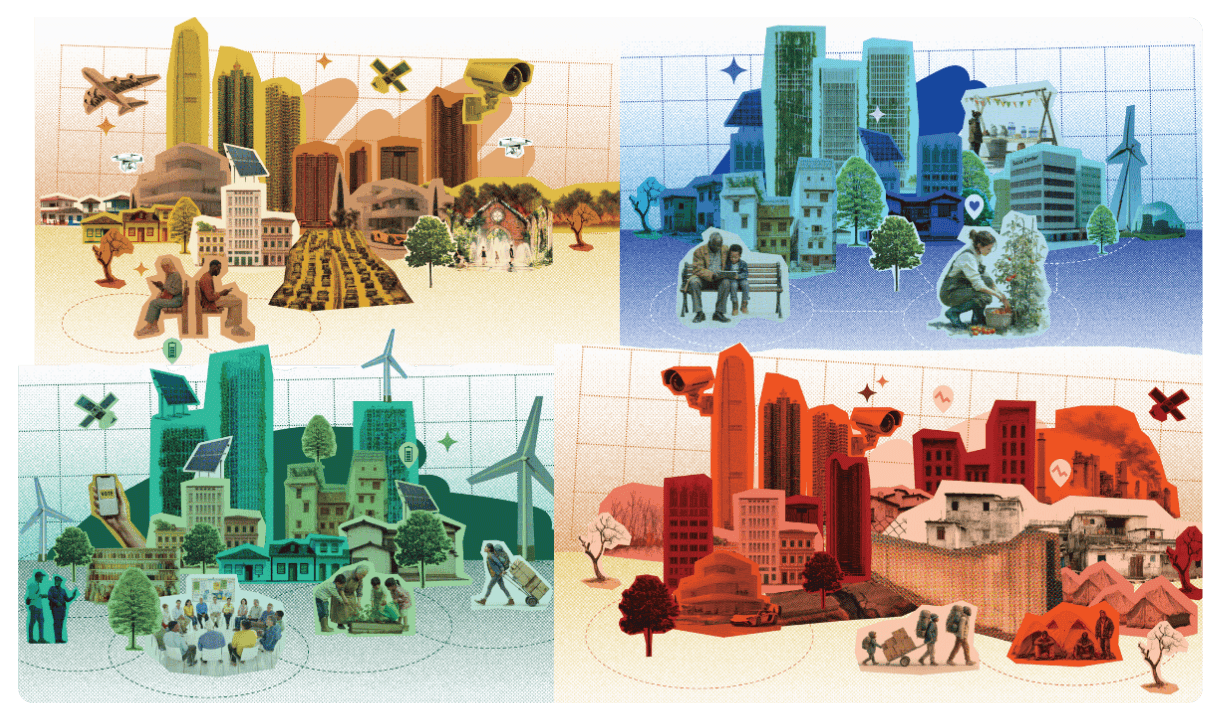
This toolkit grew out of Metropolis’ collaboration with the United Nations Development Programme (UNDP) to support global cities in mainstreaming foresight. Together with city representatives from around the world, we explored the Future of Cities 2040 using the foresight methodology you will find here. Our foresight project resulted in the four future scenarios seen above (Baseline, New Equilibrium, Transformation, Decline), explored in a workshop with city leaders through stories, artifacts from the future, and collective reflection. The experience showed that when cities imagine futures, they build the capacity to shape them.
The insights from that collaboration now inform this toolkit. Drawing on UNDP’s Next Gen Training model, it explains a six-step process for city teams to introduce foresight into planning and policy.
Below, we introduce the six core steps of strategic foresight. After familiarising yourself with the process, you can dive deeper into our dedicated toolkits on Mapping, Influencing, and Mainstreaming, packed with instructions, templates, and workshop ideas. Designed for cities at any stage of their foresight journey, it’s an open invitation to explore, experiment, and build a futures culture in your municipality.
1Framing
Domain mapping
Before you look ahead, you need to know what you’re looking at. Framing means defining the scope of your foresight project. Which systems, stakeholders, and subjects will shape your city’s future?
For the Future of Cities 2040 project, we started with a big question: What does the future look like for the world’s biggest cities? This meant defining a broad domain: urban planning, sustainability, technology, urban governance, and the social relationships that hold cities together.
With the domain described, we made a domain map; mapping all the topics that fell within scope. Your map might be broad, like ours, or focused on a specific area of work such as mobility, housing, or community activation. We looked at physical systems and stakeholders, and also public attitudes, emerging policies, and shifting habits.

Tip: Keep your scope wide enough to explore change, but focused enough to act on.
Domain Map
Zoom in and out to explore, and click to bring topics and clusters into focus for easier reading.
2Scanning & Sensemaking
Scanning signals
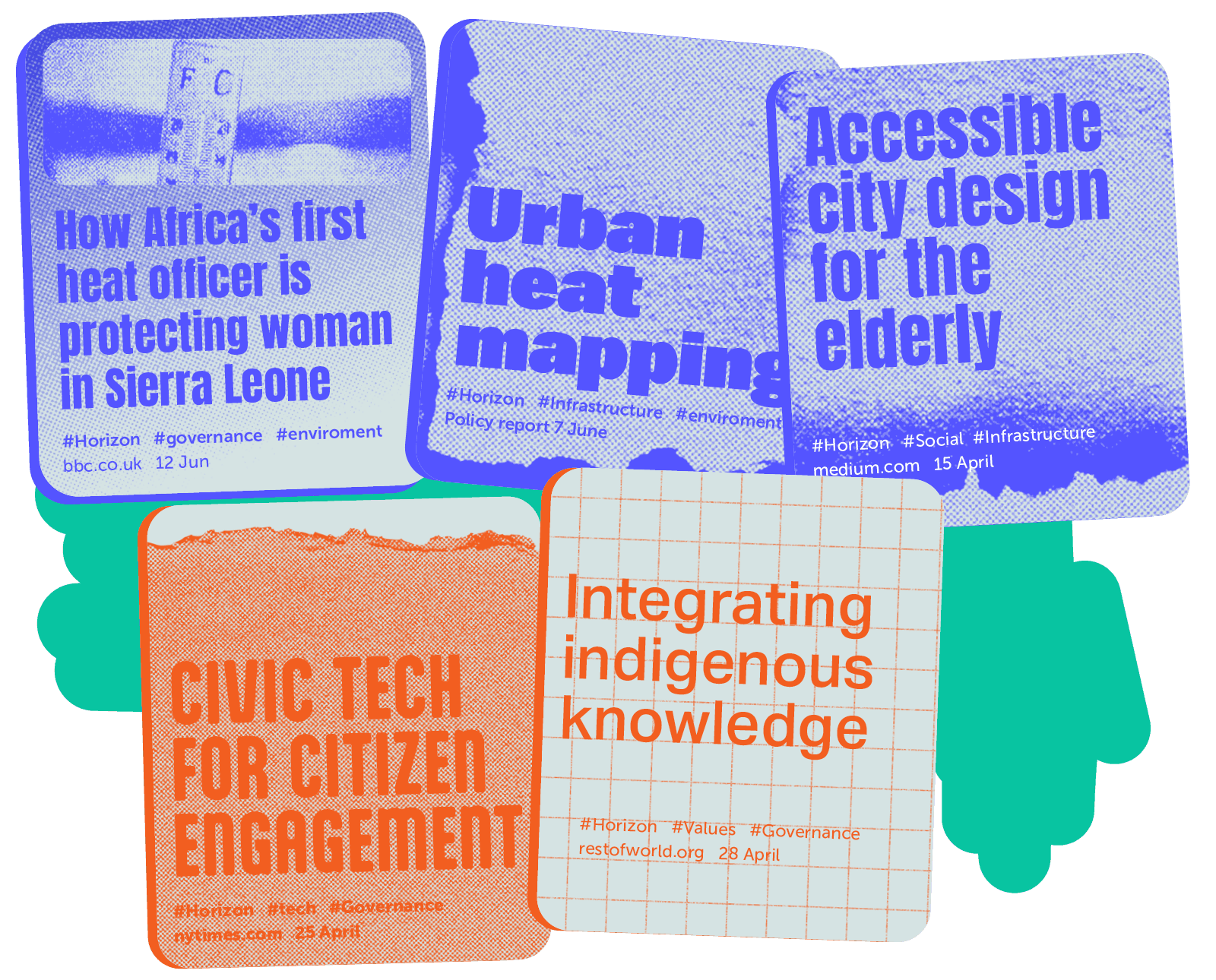
Signals are individual, sometimes surprising, clues about how the world is changing. They might appear as a new policy proposal, an experimental technology, or a shift in everyday behaviour. You can spot them in the news, blogs, conversations, research, social media, or even something unusual you observe in your city. On their own they can seem minor, but together, they help you notice where change is gathering momentum.
Scanning is the systematic collection of information about change relevant to your city’s domain. Because signals are qualitative, you’ll need an organised collection of them to build a solid evidence base.
Tip: Make scanning a regular part of your organisation’s foresight practice. Set up an internal signal board, with an ordered signal capturing system.
When scanning for the Future of Cities 2040, we drew on signals from policies, our network, and global news. We organised our signals according to our domain map. Over time, our signals became an ever-changing archive of possibility, the raw material from which scenarios and strategies could grow.
Making sense of signals
Once you have collected signals, you need to start sense making. This process, best done collaboratively, turns scattered observations into shared understanding.
For the Future of Cities 2040, we used the Futures Triangle to organise our signals and identify the deeper forces shaping urban futures. It’s a simple tool that shows how forces pull a system in different directions:
- The weight of the past: Enduring legacies and dependencies that resist change.
- The push of the present: Active momentum from current trends.
- The pull of the future: Aspirational visions, emerging ideas and desired outcomes that are not yet realised.
Mapping signals across these three forces helped clarify patterns, or drivers, shaping the system over the long term.
Identifying drivers of change
While signals are small, specific moments demonstrating evidence of change, drivers are the currents beneath the surface.
A driver might be a technological innovation, like AI, a demographic transition, such as an ageing population, or shifting social values, like rising expectations for equality. Drivers don’t have a single direction or speed, but they exert influence on change over time. Some are strong and visible, others slow and structural.
Drivers are a bridge between scanning and scenario building. They emerge when you cluster and analyse the signals you’ve gathered and begin to see patterns across them.
For a typical foresight project, you will identify anywhere from 5 to upwards of 20 drivers - for the Future of Cities 2040, we identified 8, using the Drivers Template to record them, and the Cross-Drivers Matrix to understand how they impact one another.
Futures Triangle
Zoom in and out to focus on a driver, conclusion/question, or signal, and read its content more clearly.
Drivers
Conclusions/Questions
Signals
3Futuring
Creating scenarios
Scenarios are stories about the future that help us see beyond a single forecast. They’re not predictions, but tools to challenge our assumptions so we can make better choices in the present.
There are many ways to build scenarios, but two simple approaches are:
- 2×2 scenarios: Use 2×2 scenarios to prepare strategies for specific uncertainties. This method helps you explore how two uncertainties might interact to create four very different future scenarios. Uncertainties are the big, unanswered questions that could push your city’s future in very different directions.
- Archetypal scenarios: Scenario archetypes are recurring story patterns (continuation, collapse, new equilibrium, transformation) that provide a stage to consider how drivers might unfold in different future paths. They simplify complexity, helping teams explore the bigger picture, compare contrasting futures and clarify what they hope to work toward.
In the Future of Cities 2040 project, we used our drivers and uncertainties to build four archetypal futures for cities: Baseline/Continuation, New Equilibrium, Transformation, and Decline/Collapse. During the workshop, these archetypes helped city leaders imagine themselves in four distinct urban worlds. Starting from the same set of forces, each archetype offered a different story about what cities might become, and what it would mean for planning, governance, and daily life.
Exploring scenarios
Scenarios become more powerful when stakeholders can step into them. During the Future of Cities 2040 workshop, we used speculative objects like artefacts from the future, roleplay, and a magazine from 2040 to bring each future to life. This allowed city leaders to inhabit and co-create the scenarios.
Participants arrived in the workshop, set in the year 2040, as delegates who had time travelled from different urban futures: a Community Joy Designer, an AI Mediator navigating digital bureaucracy, the Head of Water Distribution fighting scarcity. These roles helped participants understand how each future felt from the inside.
Not every foresight exercise needs immersive production, but even a small element of co-creation can help participants take ownership of the future. All of the materials we developed for the workshop are available for you to download, adapt, and use in your own city’s foresight activities in the Mapping toolkit below.
4Visioning
Defining your preferred future
The next step is to make foresight practical by clarifying the future city you want to work towards. Visioning is the process of articulating a preferred future, a shift from exploring what could happen to describing what should happen.
Before defining that vision, it can help to examine the implications of each scenario on your city. With these implications in mind, visioning invites stakeholders to imagine success in concrete, sensory terms. During the Future of Cities 2040, we asked: If it were 2040 and everything we’ve worked toward had succeeded, what would our city look and feel like? Who thrives there? What is different because of the choices we made today? These conversations provide the raw material for stakeholders to develop a plausible vision of their preferred future city.
5Designing
Wind tunnelling your strategies
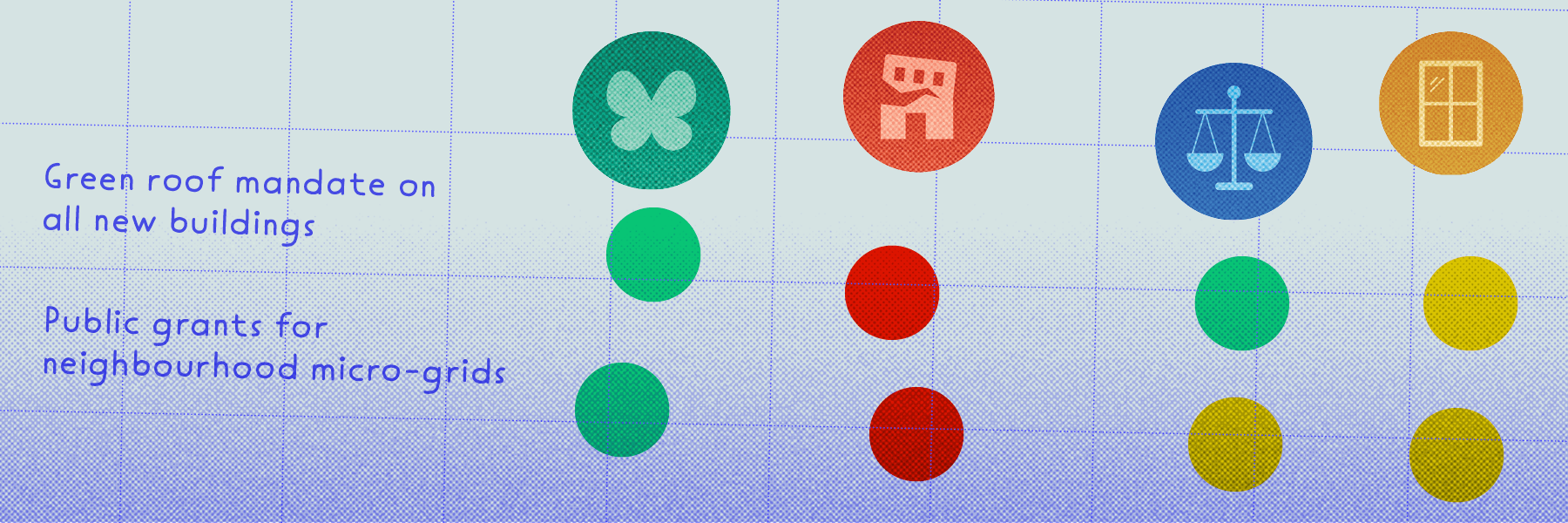
With a clear picture of your preferred future, the next step is to make progress toward it. Wind tunnelling is a way to stress-test strategies against all your scenarios, helping you identify which ideas are most likely to succeed across multiple plausible pathways.
In the Future of Cities 2040 workshop we asked: How does a green-roof strategy for heat management perform in the Transformation scenario? And what happens to it in Decline? Wind tunnelling reveals where an idea is resilient, where it’s fragile, and where it may need adaptation to remain effective.
6Adapting
Adapting your policies
Foresight helps cities explore possibilities and clarify direction; but this is only the beginning. For futures work to have impact, it must lead to action and policy adaptation.
Shaping the future is a collective effort. To build a future that is equitable and sustainable, a wide range of voices, especially those often underrepresented, need to be involved in imagining it. Meaningful change requires community and cross-department buy-in, which means engaging stakeholders throughout the process, not only at the end.
Many of the steps described in this toolkit are most effective when done collaboratively. Our Influencing Toolkit offers templates and workshop formats that help bring people together around shared futures. Our Mainstreaming Toolkit provides guidance on embedding foresight into everyday decision-making so the work continues beyond a single project.
In the Future of Cities 2040 workshop, we closed by placing our hopes and commitments into a time capsule as a reminder that the future is not fixed: every decision builds momentum, and every intervention can shift the long-term trajectory. Your city’s preferred future begins with the first step you decide to take together.